Understanding What You Are Doing, Before You Do it.
-pre-imagining your work, street methods, and show sizes.

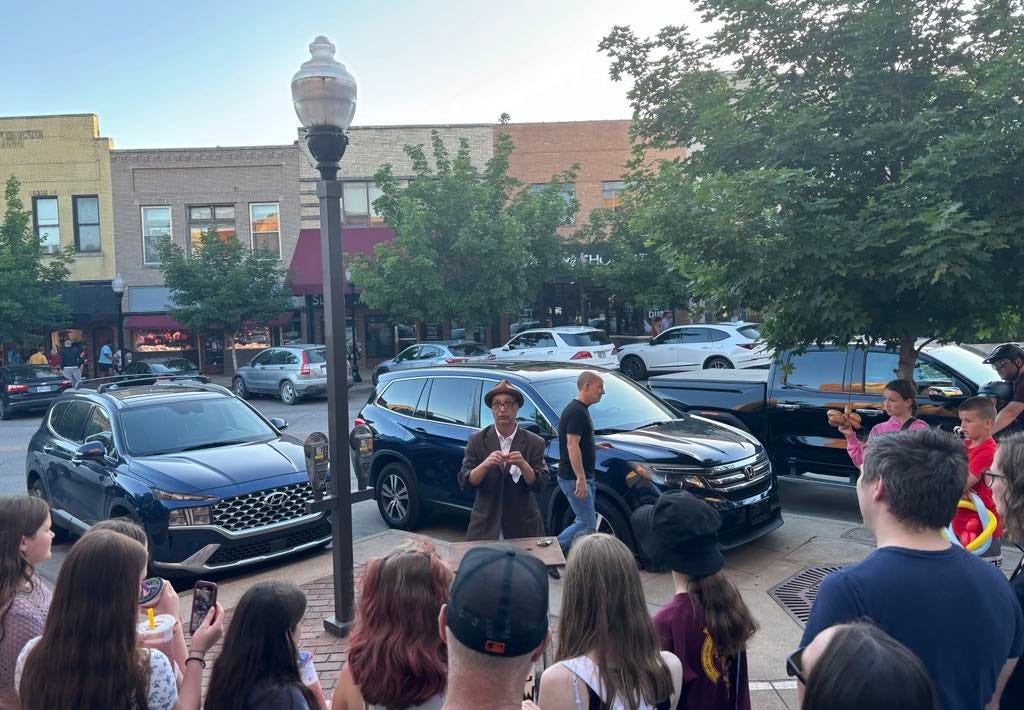
This article today is a nice reflection for the pro, but it is really directed to all the beginners out there.
Whenever I am teaching my students on the street, I have found that beginners are usually just trying to make anything work, on a wing and a prayer.
This is great if you're trying to find yourself and figure out what works, but after a while it just turns out to be chaotic and frustrating.
So I encourage my students to try and envision their show first.
I have them stand on their pitch and look.
I try and get them to see what they themselves, and their audience, will be watching, and experiencing on that pitch, before they even begin, and then I have them step forward and make it happen.
After all, how is the audience supposed to understand your program if you don't?
Before doing a show, you need to know what type of show you are going to do!
You may want to do a close up, parlor, or stage show on the street, but whatever you do, you have to set up and organize the crowd to present your work, and then get paid to do it.
Remember the goal of every busker is to get the people to stop, stay, and pay.
There are different methods to do this depending on the size and length of your show.
You should choose a method that best suits the needs of the show you want to do.
Here are some standard show sizes:
The Close Up or Sidewalk Show.
This is a short show around 6 - 12 mins long, with only a handful of people and therefore it demands a quick crowd build, and a brisk steady tempo to finale and ask for the money.
To start, the entire crowd walking by on the sidewalk needs to stop walking all at once, turn to you, and then be brought in as close as possible.
This can be done with a very flamboyant mime, or a loud sharp patter, while using simple to understand large visual effects.
After they are brought in, they are held in place by using steady mime or patter and presentation that has been designed to hold their attention.
Peppered throughout the show, they are told that they need to tip you at the end of the show. Remind them stronger before and after the finale.
This type of show is repeated back to back all day long to make a decent day's wages.
The Parlor or Half Circle Show.
This is the same method, except the tempo is slowed down, and the program will run longer, around 15 - 25 minutes, with a larger crowd, usually 25 people or more.
This begins much like the close up show, the entire sidewalk is stopped and brought in tight for commitment sake, but then after an Show Intro Routine they are backed up away from the performer to create a larger edge to present the parlor size material more comfortably.
This of course isn't always needed if the crowd is a strongly committed one, and just builds themselves into a nice sized half circle edge of their own. This happens quite a bit at booked festivals, or venues familiar with buskers.
The Stage or Circle Show.
This is the big show, 35-45 min with giant crowds.
This can be started in two ways: by progressing up the ladder from a close up show, to a parlor show, and then bigger, allowing the show itself to grow in size with tactics or organically, or with a slow crowd build technique before even presenting a show.
In other words you can entertain your audience with magic while the audience gets bigger and you can keep calling for more people to come and watch.
Or, you can simply stall them with crowd building techniques and ploys like Clap And Cheer. This is where you get the audience to clap and cheer like a game to attract more people.
Some performers use Stand Up Comedy to entertain the crowd while they wait and stall for it to get big enough to present their actual show.
This technique of stalling before one begins a show, is called a "Slow Build."
This is all done, because a large production usually needs a large audience, and it can take a while for the people to show up and move into position.
The Circle Show, has a much much slower tempo than the other two shows, because its motivation is different.
Its motivation of course is to attract those people who are willing to stay 30 or 45 minutes, or more.
I prefer the first method of progressing through show sizes, because I like to just jump in and get started with my show, it also allows me to work any pitch and any crowd size, appealing to what the people want to do and not locking me into one size sink or swim.
For instance, if the people don't want to stay past my close up show, I could just stop there, and end my show early and still get paid.
This would be difficult to do, if not impossible, with the Slow Build And Stall method.
But again, it's just my preference.
CHOOSING THE SIZE AND METHOD OF YOUR SHOW:
Understand that a pro on the street can perform any of these methods.
If you desire to be a pro you will need to know how to do all of them.
Different sizes and methods should be used to fit the venue.
If you have the luxury to do whatever you want on your venue, or in other words, if there are pitches of various sizes and lots of foot traffic, then the decision is a simple one, do what you would love to do most.
MY CHOICE:
I have done all of these, but I prefer to do Close Up.
But if I need money and if the venue calls for it, I’ll do Half Circle Shows. This has worked best for me in my career on the street.
Sometimes I’ll work close up most of the day and just do a couple of Half Circles to get my daily income up.
I did Circle Shows a lot when I was younger, but I’m getting older and I just don’t have the energy anymore.
Usually the only time I do circle shows now, is if I am hired by a private function or festival to do circle shows.
Occasionally while busking on the street my small show may grow into a circle Show. If that's what the people want, then I will slow the tempo down and put in more material.
But again the most important point of all this is to know what the show is going to look like before you present it to an audience.
This way, you and your audience will know what's going on.
FINAL THOUGHTS:
Stop thinking about money.
People smell desperation.
Do what you love and the money will follow.
Instead of money being your goal, let quality be your goal.
Go out there and play with the people, if everyone has a good time you have met your goal.
If you go out there with money as your goal and you don't get the money you think you should, you're going to get mad, and this will affect all your following shows.
If you do this you're going to have a bad day.
But if your goal was to have a good show, and you meet that goal, you will be satisfied and happy.
And you will be shocked at how much more money you make when you don't care about it.
I've always made bigger money when I didn't care.
Speaking of which you can leave me a tip here if you'd like.
This is an excellent analysis and valuable advice for all who want to work the streets or are working thete already! Keeps you sharp!
Thank you. It's like you read my mind, and told me exactly what I needed to hear.